Maharashtra’s Water Future Cannot Depend on “Normal” Monsoon Averages
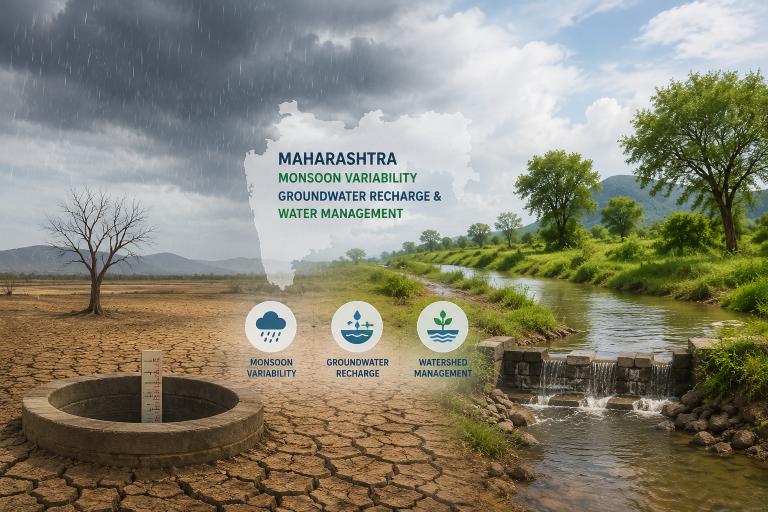
The projection by the India Meteorological Department of a below-normal monsoon in 2026—estimated at 92% of the Long Period Average and influenced by emerging El Niño conditions—should not be viewed as a routine seasonal deficit. In Maharashtra, where water security largely depends on monsoon behaviour, even a modest rainfall deficit can create serious challenges.
Over the past decade, rainfall patterns in Maharashtra have undergone a significant transformation. It is no longer the total annual rainfall that defines the monsoon season, but its erratic timing, uneven distribution, and increasing tendency to occur in short, high-intensity bursts. Rainfall events exceeding 100–200 mm are recurring more frequently. The Mumbai floods of 2005 remain one of the major examples of such extreme rainfall events.
Long-term rainfall data from 1979 to 2025 may not show any dramatic rise or decline in annual rainfall, creating an impression of stability. However, this masks a deeper climatic variability. Regional trends reveal growing disparities across the state. While Konkan and parts of Vidarbha have experienced increasing rainfall trends, regions such as Pune and Nashik have shown declining tendencies.
At the same time, the recent decade from 2014 to 2023 has recorded strengthening monsoon rainfall across divisions despite multiple El Niño years. This suggests that traditional climate signals are becoming increasingly unpredictable. The real challenge, therefore, is not scarcity alone but uncertainty—a monsoon that is becoming less reliable, more uneven, and increasingly extreme.
Treating a 92% monsoon forecast as “near normal” risks creating complacency. In reality, it highlights the urgent need to rethink water planning for a future where variability matters more than averages.
Rainfall and Groundwater Relationship
Rainfall continues to determine the condition of groundwater resources in Maharashtra. Between 2014 and 2023, many parts of the state witnessed noticeable improvements in groundwater levels due to improved monsoon rainfall and enhanced recharge.
Districts like Aurangabad, where rainfall has increased sharply, have shown significant groundwater improvement. However, regions such as Nashik and Amravati have recorded only modest groundwater gains, reflecting the uneven distribution of rainfall itself.
Groundwater does not respond uniformly to rainfall. It responds to a complex hydrological system involving:
- Geological formations
- Aquifer characteristics
- Land use
- Physiography
- Intensity of groundwater extraction
These factors control the extent of groundwater recharge. In some regions, favourable lithology and controlled abstraction have amplified the benefits of good rainfall, while in others, the same rainfall has resulted in limited recharge.
The Konkan region demonstrates this contrast clearly. Despite receiving nearly 2000–2500 mm of rainfall annually, many areas experience water scarcity from March onwards.
Changing Nature of the Monsoon
Nearly 80–85% of Maharashtra’s rainfall still occurs during the southwest monsoon months between June and September. However, the nature of the monsoon has fundamentally changed.
The monsoon is no longer a steady and predictable source of water. Instead, rainfall is increasingly arriving in intense bursts followed by prolonged dry spells. Under such conditions, measuring annual rainfall alone is no longer meaningful.
Extreme rainfall events generate rapid runoff, sending large quantities of water toward the sea even as inland regions face scarcity only weeks later. The real challenge lies in effectively capturing, storing, and distributing this runoff.
Hard Rock Aquifers and Water Storage Challenges
About 90% of Maharashtra is underlain by hard-rock aquifers consisting mainly of basalt, granite, and gneiss formations. These aquifers behave very differently from alluvial systems.
Hard-rock aquifers are:
- Discontinuous
- Shallow
- Limited in storage capacity
Water is mainly stored within weathered zones and fractures, making groundwater systems highly sensitive to rainfall variability and extraction pressure.
Importance of Watershed-Based Management
Watershed-based planning remains one of the most effective approaches for addressing rainfall variability in Maharashtra.
By:
- slowing runoff,
- increasing infiltration,
- and improving soil moisture,
watershed interventions help address both drought and flood risks while improving groundwater sustainability.
Such interventions are important for reducing the natural outflow and depletion of groundwater.
Conclusion
The monsoon has not weakened, but it has become increasingly unpredictable. Unless water management systems evolve accordingly, abundance and scarcity will continue to coexist in Maharashtra.
The challenge before the state is no longer only about receiving rainfall, but about managing variability, conserving runoff, and improving groundwater sustainability through effective watershed-based planning.